
Our South Coast GLA:D® Program.
Written by Gerringong & Kiama Physiotherapy
If you have been told you have hip or knee osteoarthritis, you have probably been given the advice to “keep moving” or “stay active” without much detail about what it should look like. It is not especially helpful advice on its own, particularly when the joint is sore and you are not sure what is safe.
The GLA:D® program was designed to fill in that gap. It is a structured education and exercise program for people with hip or knee osteoarthritis, run in our Gerringong and Kiama clinics on the South Coast. In this blog, you will learn how common osteoarthritis is, what the full program involves, who could benefit from it, and the most frequent questions.
How common is hip and knee osteoarthritis?
Osteoarthritis is the most common form of arthritis in Australia. According to the Australian Institute of Health and Welfare, around 2.1 million Australians were living with osteoarthritis as of 2022, roughly 1 in 12 people, and it is estimated that a majority of those cases involve the knee.
It affects more women than men and is more common in people aged 45 onwards., It can also appear in people in their 30s, particularly after a previous joint injury. With an ageing population, it is a condition our clinics see regularly, in people who are active, only just starting to notice symptoms, as well as people who have been managing the condition for years.
What is the GLA:D® program?
GLA:D® stands for Good Life with osteoArthritis: Denmark. It was developed by researchers in Denmark, brought to Australia in 2016, and now runs as a not-for-profit program led by La Trobe University.
The program is built around what Australian clinical guidelines already recommend as first-line care for osteoarthritis: education, exercise and weight management. Rather than treating the joint as something that needs to be protected from movement, GLA:D® teaches you how to load it well through neuromuscular exercise, which focuses on control and stability around the joint rather than simply building bulk. You then get six weeks of supervised practice adjusted to your exercise level.
Our physiotherapists are trained and licensed to deliver the full program. You can read more about it on our GLA:D® page.
Who is this program for?
The program is designed for people with hip or knee pain or symptoms of osteoarthritis, at any level of severity. That includes people who have been managing symptoms for years, and those who have only recently started noticing stiffness or ache.
It is not recommended for a specific age. What matters the most is if the hip or knee symptoms are consistent with osteoarthritis.
Some people are better suited to a different approach. If your hip or knee pain has another cause, such as inflammatory joint disease, a fracture, or a soft tissue problem, or if you have other symptoms that are more significant than the osteoarthritis, your physiotherapist will talk with you at the assessment and suggest other options. Parts of the program may still be useful.
What happens in each phase?
You can find below the outline of the program from start to finish:
Phase 1: Your initial assessment
You will meet with one of our trained physiotherapists. They will talk through your history, your symptoms and what you want to get back to doing, then take baseline measurements of your functional ability, for example how you rise from a chair, how far you can walk, and how your joint moves. These measurements are repeated later so you can see what has changed.
This is also the session where you ask questions. Plenty of people arrive with worries about whether exercise will make things worse, and it is worth getting those answered properly before you start.
Phase 2: Two education sessions
Two one-hour group sessions covering what osteoarthritis is, what influences it, what the treatment options are, and the self-management strategies that can help day to day.
Phase 3: Twelve supervised exercise sessions
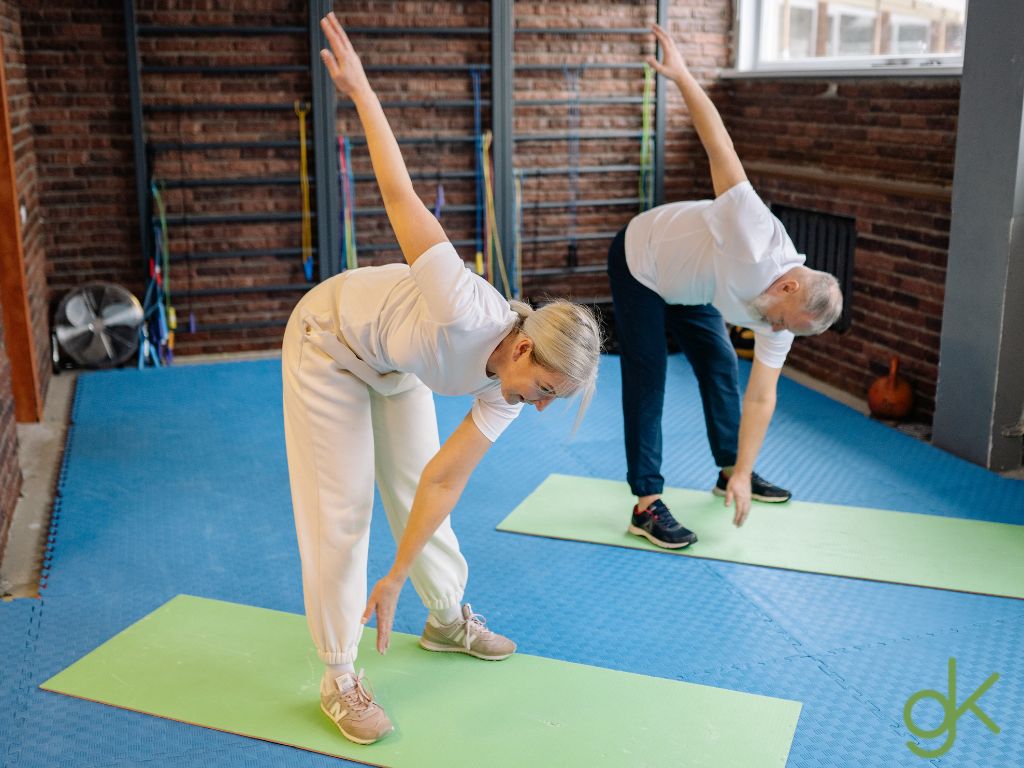
Two sessions a week for six weeks, in a small group of up to six people, held at either our Gerringong or Kiama clinic. Sessions generally combine a warm-up, targeted strength and control exercises for the hip or knee, and functional movements that carry across into everyday tasks such as standing up, walking and climbing stairs. Every exercise is adapted to your level by a clinician, so you are not working through a generic class plan.
The focus is on neuromuscular control, joint stability and strength, which is to say, teaching the muscles around the joint to do their job properly. If you need to miss a session, up to two make-up classes are available.
Phase 4: Your review
Three months after your initial assessment you come back in, re-do the functional measurements, and talk about the next steps. For most people, that means continuing with exercise in some form, whether that is a home program, a gym, or one of our group exercise classes.
Ongoing Questionnaires
As part of the national research initiative, you will be asked to complete questionnaires at registration and again at three and twelve months. The data is de-identified and feeds back into improving osteoarthritis care across Australia.
What does the research show?
Data from the GLA:D® Australia program has shown reductions in pain and in pain medication use that were sustained at twelve months, along with improvements in how people move and in their confidence managing the condition.
Results do vary from person to person, and no exercise program can promise a particular outcome for any individual. What the program offers is a structured, evidence-informed approach delivered by trained clinicians, with measurements along the way so you can see how you are tracking.
For some people, the program has helped delay or avoid joint replacement surgery. For others, surgery still turns out to be the right decision, and arriving at it with stronger muscles and a better understanding of rehabilitation is rarely a wasted effort.
Do I need a referral?
No. You do not need a referral from your GP to join the GLA:D® program at our clinics. You can book an initial assessment directly.
If you do have a GP Chronic Condition Management Plan, eligible participants may be able to use Medicare funding towards assessment costs, though not the classes themselves. Private health rebates depend on your fund and are worth confirming with your insurer before you start. If you are with HCF, let us know when you book, as we are registered providers for their GLA:D® member feedback program.
What if GLA:D® is not the right fit?
Hip and knee pain have plenty of causes, and osteoarthritis is only one of them. If the assessment points elsewhere, we have other services that may be more appropriate, including one-on-one physiotherapy, exercise physiology, and remedial massage. We also run a vestibular and balance clinic for people whose main concern is dizziness or unsteadiness, a TMJ clinic for jaw pain, and Southern Coast Pelvic Health for bladder, bowel and pelvic floor concerns.
The point of the assessment is to work out what will actually help you, not to fit you into a program.
FAQs
Taking the first step
If hip or knee pain is getting in the way of walking the headland, keeping up with grandchildren, or simply getting out of a chair comfortably, it is worth having a conversation about it.
Call us on 02 4234 4666 to book an initial assessment, or read more about the GLA:D® program first. You will find more articles on managing pain and staying active on our Physio Tips & Advice blog.
This article provides general information only and is not a substitute for individual assessment or advice from a qualified health practitioner. Outcomes vary between individuals. Please speak with your physiotherapist or GP about what is appropriate for your circumstances.
References
Australian Institute of Health and Welfare. (2024). Osteoarthritis. Australian Government. https://www.aihw.gov.au/reports/chronic-musculoskeletal-conditions/osteoarthritis
Barton, C. J., Kemp, J. L., Nelligan, R. K., Mosler, A. B., Agaliotis, M., Sherburn, M., & Hinman, R. S. (2021). Program evaluation of GLA:D® Australia: Physiotherapist training outcomes and effectiveness of implementation for people with knee osteoarthritis. Osteoarthritis and Cartilage Open, 3(3), 100183. https://doi.org/10.1016/j.ocarto.2021.100183
The Royal Australian College of General Practitioners. (2018). Guideline for the management of knee and hip osteoarthritis (2nd ed.). RACGP. https://www.racgp.org.au/clinical-resources/clinical-guidelines/key-racgp-guidelines/view-all-racgp-guidelines/osteoarthritis
Yeo, M. G. H., Ackerman, I. N., Bohensky, M., Wang, Y., de Steiger, R., & Cicuttini, F. (2022). Global Burden of Disease Study 2019: An opportunity to understand the growing prevalence and impact of hip, knee, hand and other osteoarthritis in Australia. Internal Medicine Journal, 52(12), 2127–2136. https://doi.org/10.1111/imj.15913